After finishing Circling Cold, another image lingered in my thoughts and refused to let go, see the inspiration below. It stirred two very different memories. The first was my own childhood experience with piano lessons. There was ample frustration and a demand for discipline in those early lessons, and yet, in hindsight, they formed the foundation for my limited musical knowledge. The second was far less personal, but no less vivid. It was the life-draining machine from The Princess Bride, a device designed not to kill outright, but to take only what was needed.
Those ideas fused into multiple questions. What if mastery itself required a measurable cost? What if inspiration could be refined, controlled, and harvested, just enough to perfect a work without destroying its source?
Those questions became the seed for the story that follows. The studio had been designed for patience.
Tall windows admitted only narrow shafts of daylight, softened by age and dust, while the rest of the room lived in a deliberate half-shadow. Time behaved differently there. It was slower and heavier. Yet, everything was measured not by clocks but by the careful placement of canvases, instruments, and tools left precisely where they would be needed again.
Aaron preferred it that way. Inspiration, he believed, required structure. Silence mattered. Preparation mattered more. Even the smallest disruption could fracture the focus necessary to bring a work to completion. When everything was aligned, the room itself seemed to hold its breath, signaling that creation could finally begin.
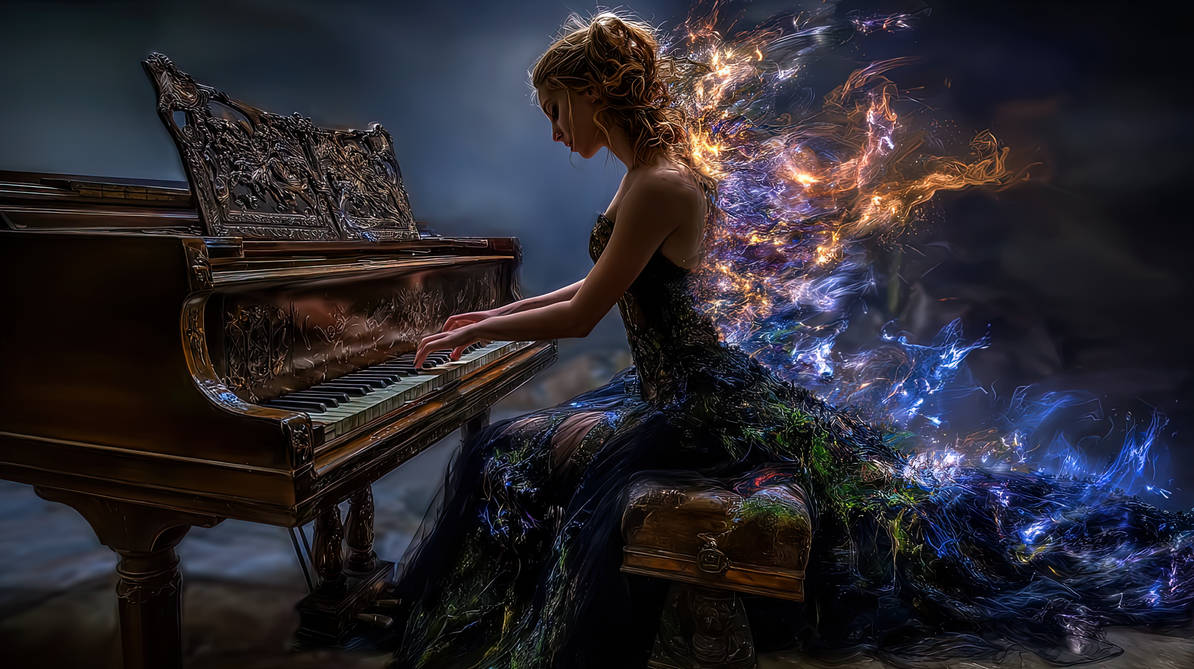
It had been some time since the studio had last heard music. The piano waited in quiet expectation, its polished surface reflecting the faint glow of the room, while a blank canvas stood nearby, ready to accept whatever form would ultimately claim it. When the door opened, the stillness did not break. It shifted.
The studio’s dim lights washed over Aaron as he circled the grand piano, his fingertips caressing the instrument in an intimately familiar way. With each step, his breathing deepened as his pace slowed. When he completed his current pass, his gaze lifted to the door, settling on Mara.
“Hello,” he said flashing her a warm smile as he waved at her. “Thank you for coming by.”
“Why’d you insist on my coming?”

He lifted the cover, revealing the keys before tapping the sheets laid out on the ornate music stand. “I’m looking for you to play while I paint.”
Mara rolled her eyes as her shoulders slumped. “What happened to Tabitha?”
Arron closed his eyes and tapped the music. “She can’t play for me anymore.”
“That’s a little abstract.” Mara said, folding her arms across her chest and leaning against the doorframe. “Why can’t she help you?”
“She left,” Aaron said, thumping the piano, creating a predatory false heartbeat. “I do need someone skilled to play to inspire my greatest work.”
“Fine.” Mara rubbed her eyes as she walked to the piano and slipped into the seat. She licked her lips as her finger raced across the lines. Once she finished reading the music, she looked over at Aaron. “This isn’t an easy piece. Are you sure that Tabitha can’t come and play for you?”
Aaron laid a hand on her back and leaned down next to her ear. “You’re a fantastic pianist. Trust me, you’ll do wonderfully.”
“All right, I’ll give it my best.” She interlaced her fingers and pulled them down before positioning her fingertips over the keys and taking a calming breath. “Are you ready?”
Aaron hurried over to the canvas sitting on its easel and the paints resting nearby. He plucked a brush from the table to his right and positioned its tip on the blank surface. “I’m ready when you are.”
“Here goes nothing,” Mara said as her fingers began tickling the smooth black and white keys. Light shimmered through the high and narrow windows, catching drifting dust motes that sparkled like suspended musical notes, rising from the piano.
“Excellent,” Aaron said as streams of light siphoned from Mara’s body and slammed into the canvas. As the sweet notes of the song caressed his ears and the canvas, Aaron dragged the brush across its surface, teasing form and color into the painting.
Aaron spared Mara a measured glance as color seeped from her body, then returned his full attention to his burgeoning masterpiece. He raised the brush toward a darkened corner of the canvas, and as the bristles neared it, the colors already there and infused into the canvas shifted.
As they spiraled, they transitioned from a vortex of color into a defined image following Aaron’s will. Mara sucked in a breath as the air thickened, vibrating gently, as if some unseen orchestra readied their bows and horns. Sweeps of Aaron’s brush bent light, colors, and even shapes. The paint on the canvas rippled, acting more like sound waves than physical paint. The sudden gold flared like a trumpet’s blare. A section of Indigo unfurled like low cello notes. And a few spots of crimson spun upward, creating a crescendo of fire.
Aaron felt Mara’s performance guided his brush, developing his confidence, pushing any fear or hesitation out of his mind. This method always created masterpieces, though with a price. His brush flew about the canvas with measured and practiced motions, enhancing the scene’s beauty with Mara’s efforts.
When the color vanished from her shoulders, Aaron released the brush, and it continued to bring definition to the canvas. He hurried over to her and gripped her shoulder, silencing the piano. His brush clattered on the floor as he tapped the sheet music. “You played wonderfully.”
Mara drew in a sharp breath as her skin reclaimed some color. She wiped her brow and exhaled. “I’m surprised I was able to play that as well as I did. But you made me stop early. I was almost done.”
“I’m aware,” Aaron said, rubbing her back as the last patch of skin reclaimed part of its original hue. “However, to complete this masterpiece, we need to take a break. Do you think you’ll be able to return tomorrow and play it again for me.”
“How can you be almost done? Wasn’t it blank when I came in?” Mara asked as she rose and fell back onto her butt. “I’ll need a brief rest before looking or even leaving.”
A chuckle washed over Mara as Aaron reclaimed his brush from the floor. He put it down before covering the painting. He lifted the linen sheet and studied the painting’s progress. While the background was nearly complete, the central figure was nothing but a blurry dream.
He lowered the cloth and hurried back to Mara, rubbing his hands together. “Will you be able to come back tomorrow and perform the song again?”
“Yeah,” Mara said, standing up on unsteady legs. She turned to Aaron and laid her hand on the piano. “Could you wait a day for me to recover? Something’s wrong, and I don’t know why.”
Aaron glanced at his covered easel. “I can wait another day. Come back when you feel better and we’ll finish my masterpiece.”
“Thank you for your understanding.” Mara walked forward, her gait unsteady. She paused before the door and pointed at the painting hanging just beyond it. She cocked her head a little and inched toward the artwork rather than the exit. She rubbed her lip and glanced at Aaron, who was studying his latest work in progress. “Was this the painting you did with Tabitha’s help?”
Aaron turned and grinned. “That is what she helped me create.”
“It’s beautiful, but unnerving.”
“I’m sure you’ll love the painting you help me complete more.”
Mara nodded, sucking on her lip as she eyed the landscape and its familiar ballerina. “Thank you for agreeing to the delay. I’ll see you in a couple of days.”